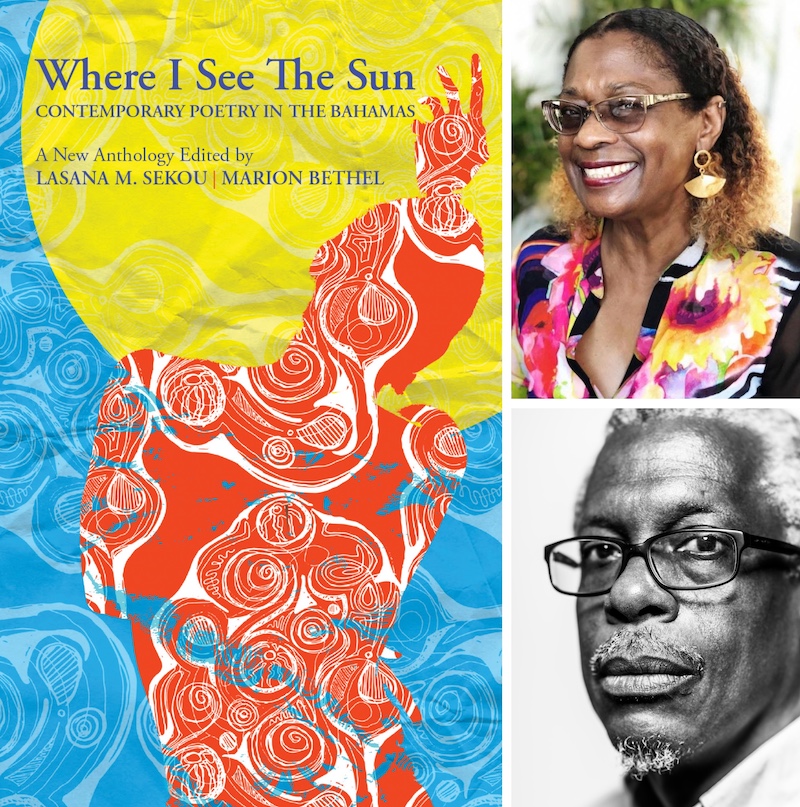
Where I See The Sun: Contemporary Poetry in The Bahamas, edited by Lasana M. Sekou and Marion Bethel, brings together 58 Bahamian writers, from emerging young poets publishing for the first time to established senior authors.
“With over 3,000 islands and sea cays in The Bahamas, is it surprising that Where I See The Sun, this long-needed anthology of Bahamian writing, ranges so marvellously? I almost wept at the fierce generosity of inclusion found here,” said Forward Prize and Bocas Prize winner Anthony V. Capildeo in a critique of the book.
Contributors to the 281-page anthology from House of Nehesi Publishers (HNP), including Marion Bethel, Christian Campbell, Lelawattee Manoo-Rahming, Sonia Farmer, Obediah Michael Smith, and Lynn Sweeting are well known for their national and international literary awards and distinctions.
Their work appears alongside that of emerging poets such as Tanicia Pratt, Georgio Russell, kevante ac cash and Letitia Pratt. Some have already published collections, chapbooks and books in The Bahamas and abroad.
The anthology also features Suhayla Hepburn, Leon Rolle, Nakia Pearson, Eugene Elira, Sasha Wells, Sara Bastian, Ide Amari Thompson, Angelique Nixon, and Xan Xi Bethel. Their contributions offer readers, educators and lovers of literature, young and old, exciting discoveries, said HNP president Jacqueline Sample.
To Jamaican poet laureate Kwame Dawes, “The poets featured … have solidified the important position of Bahamian poetry as a necessary way to understand the ideas of nation in The Bahamas and the idea of regionalism in the Caribbean.”
Where I See The Sun: Contemporary Poetry in The Bahamas is available in the Bahamas at Doongalik Studios, The National Art Gallery, Logos Bookstore, and UB Chapter One Bookstore; online at libroslatinos.com; and in St. Martin at Arnia Bookstore.
The selections of the book illustrate a cohesiveness that is “distinct to the experiences of the people who live, love, fight, lose, cry, laugh, and survive within the Bahamian archipelagic space,” said Dr. Craig Smith, Dean of the College of Liberal and Fine Arts at the University of The Bahamas, in his foreword to the publication.
An example of the poetic range is Inderia Reeba Green’s “They Call Me Kate,” a remembrance of Bahamian national hero Kate Moss, who modeled courage and resistance to brutal oppression as a 14-year-old enslaved girl in the early 1800s. It imagines Kate’s voice in the Bahamian tongue, offering young Bahamians an interactive heritage to be recited, studied, and embodied as an expression of national identity and culture.
The only non-“contemporary” poet in Where I See The Sun, John Boyd dates from the 1800s and is thought to be the first Black Bahamian to publish a book of poetry. His “Sketch of a Varying Sky” (1834) opens the volume. It adds a “grounding of Lucayan literary legacy” to the diversity of today’s contributors, forms, and subject matter, said Sekou, who is also an author from the Caribbean island of St. Martin.
Co-editor Bethel describes the contributors as “sun grown souls” whose voices carry urgent critical relevance. Their work is gathered in what Canadian cultural critic Faizal Deen calls “a living archive of Lucayan voice, vision, and future.”
Where I See The Sun also highlights what Bethel describes as poetic energy, resistance, and steadfastness in a time marked by global degradation of people and the environment, normalized violence, and mass death and destruction.
In just 20 short lines, Heather Thompson’s “66 Steps” captures the death of Bahamian dignity at the altar of tourism. This subtle gut punch invokes the tourism plantation and demands introspection about the value of a Bahamian life.
What does a mountain landscape look like in The Bahamas? Reynold Roberts’ description is saturated with Bahamian color and specificity. What happens when you get sick on a Family Island? In “The Perils of Living on a Little Island,” Nicolette Bethel’s poetic imagination inventories the challenges of that experience.
What is it like to be a woman? Angelique Nixon’s poem offers an intergenerational testimony, eulogy and prayer to mothers, grandmothers, sisters, and aunties. What does a poem written by Mother Earth sound like? “In My Country and Our World” by Patricia Glinton-Meicholas translates the sharp tongue of a scorched earth.
“For years, Bahamian students have studied and memorized poems from anthologies of British, United States, and Caribbean poetry; this volume will help them see themselves and, in doing so, value their own experiences, language, and culture,” stated Dr. Smith.
“We hope this presentation of more than 150 poems, which scholar Prof. Carole Boyce Davies places among ‘the best of contemporary poetics from The Bahamas,’ contributes to the growth and critical exploration of Bahamian literary arts,” said Sample.
HNP and the book’s editors have attracted critical attention to Where I See The Sun from Kenya, Barbados, Colombia, Belize and the USA. Based in St. Martin, HNP has published Caribbean and U.S. literary giants, emerging writers, and noted authors from Asia, including George Lamming, Kamau Brathwaite, Amiri Baraka, Chiqui Vicioso, Emilio Jorge Rodriguez, Drisana Jack, N.C. Marks, Nidaa Khoury and Tishani Doshi.
Where I See The Sun: Contemporary Poetry in The Bahamas was launched to a standing room audience of over 200 people at the University of The Bahamas’ Harry C. Moore Library on November 14, 2026, said Sample.